Background Check searches in Multnomah County let you quickly see identity data, address history, and criminal case outcomes using the county’s public records portal. By entering a full name, date of birth, or address, you can pull arrest records, felony charges, and court dispositions that matter for employment screening or personal safety. The system pulls data from the circuit court, sheriff’s office, and state archives, giving you a clear snapshot without needing a lawyer.
Background Check results also reveal property ties, business licenses, and driving violations that often hide behind name variations. When you add a county or state filter, the search narrows to the exact individual, reducing mismatches from common names. Understanding record status—active, pending, or sealed—helps you interpret findings confidently, while the official Multnomah County Circuit Court site offers guidance on requesting certified copies for any disputed entry.
How to Search Background Check Records in Multnomah County
A Multnomah County background check pulls together publicly available records from Oregon court systems, law enforcement agencies, and state archives. Residents and employers often run these searches to confirm identity details, review through the official multnomah county or portal to review criminal history, or verify professional credentials before making a decision. Because the county covers Portland and surrounding areas, the most reliable data comes from state-level repositories that aggregate filings from all Oregon counties, including Multnomah.
The Oregon State Police Computerized Criminal History (CCH) portal acts as the central index for Oregon arrest and disposition records. For court documents, the Oregon Judicial Department’s online records search (called OJD Online) provides access to case files from the Multnomah County Circuit Court. Both systems let you enter a name, date of birth, or case number to retrieve matching entries.
Official Search Portal: https://www.oregon.gov/osp/programs/cjis/Pages/CCH.aspx
Steps to Search
- Open the Oregon State Police CCH page at the URL listed above.
- Review the eligibility rules. Public users may request their own record or, with written authorization, another person’s record, depending on Oregon Administrative Rule 257-060.
- Select the appropriate request form. The CHRI Public Records Request form works for self-searches, while the CHRI Dissemination form applies to authorized third-party requests.
- Provide the subject’s full legal name, date of birth, and any known aliases.
- Submit the signed, notarized form by mail to the CJIS Services section in Salem.
- Pay the $33 search fee plus any record-copy fees as listed on the Oregon State Police fee schedule.
- Allow processing time. Standard turnaround runs 7 to 14 business days, though backlog periods can extend this timeline.
- Use the returned CCH number to order certified copies if you need them for employment, immigration, or court filings.
For court records specifically, the Oregon Judicial Department (https://www.oregonrecordsrequest.oregon.gov) operates a separate portal where you can search by name or case number and pay for document copies. This site covers Multnomah County Circuit Court case indexes going back more than 40 years, including civil, criminal, family, and probate matters.
Information Found in a Background Check
A complete Multnomah County background check returns a structured set of identifiers and historical data. Each field serves a purpose: identifiers confirm you have the right person, and histories establish the timeline of their activity within the county and across Oregon.
Identity Information
Identity data forms the foundation of the search. Records typically show the subject’s full legal name, gender, date of birth, and a state identification number (SID) issued by the Oregon State Police. Some returns also include physical descriptors such as height, weight, and eye color, which appear on older fingerprint cards stored in the state archive.
Name Variations
Name variations matter because many people in the Portland metro area use multiple names throughout their life. The CCH system records aliases, maiden names, and former married names when they are captured in court documents. Checking every known variant reduces the risk of missing a relevant record, particularly for women who have changed surnames through marriage or divorce.
Date of Birth
A date of birth anchors the search. Without it, common-name matches can produce dozens of false positives. Most online portals allow you to narrow results to a single birth date, which often narrows the match to one person or zero results.
Address History
Address history pulls from multiple sources, including court filings, voter registrations, and Department of Motor Vehicles records. Multnomah County searches often surface past addresses in Portland, Gresham, Troutdale, and unincorporated communities such as Wood Village. Past addresses help confirm residency patterns and can be cross-referenced with utility or property records.
Record Identifiers
Record identifiers include case numbers, docket numbers, FBI numbers, and CCH tracking IDs. These codes make it possible to request certified copies and to follow a case through the appellate process. Each identifier follows a format that indicates the source court, the filing year, and the sequence in which the case was opened.
Possible Record Matches
The search engine returns possible record matches in situations where two or more individuals share the same name. Multnomah County returns the highest volume of common-name results among Oregon counties because the county has the largest population and a continuous run of historical filings. Reviewers must compare each entry’s date of birth, SID, and address history to confirm the correct individual.
Criminal Records in a Background Check
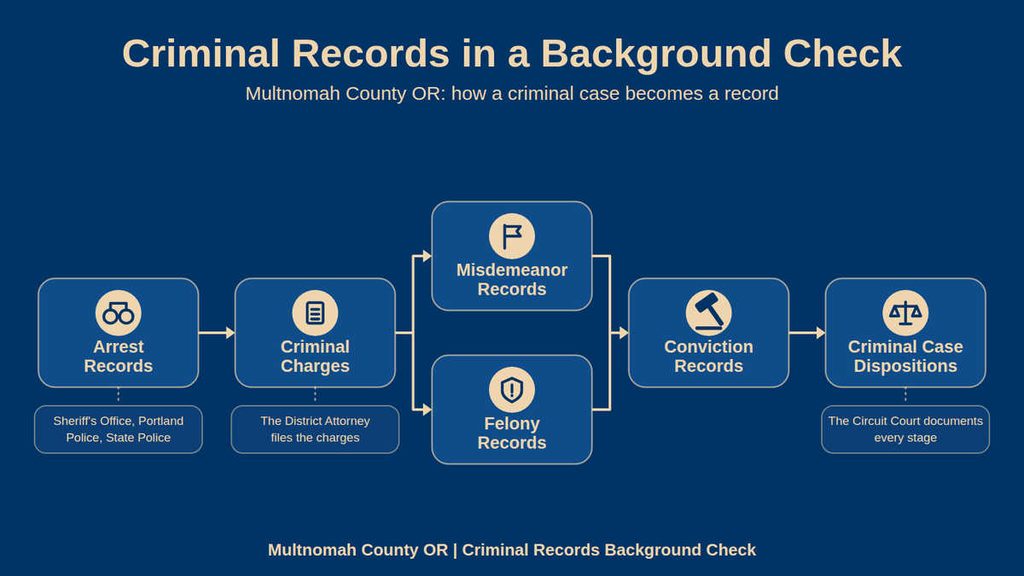
Criminal records make up the most-requested component of a Multnomah County background check. They originate with law enforcement agencies, the Multnomah County Sheriff’s Office, Portland Police Bureau, and the Oregon State Police. After arrests, the Multnomah County District Attorney files charges, and the Circuit Court documents every stage of the case.
Arrest Records
Arrest records include the date, location, arresting agency, and alleged offense. They appear in the CCH system after the agency submits fingerprint cards and disposition data. Arrest records remain visible even if charges are dismissed, unless a court orders them sealed or expunged.
Criminal Charges
Criminal charges show the statutory violation cited by the prosecutor. In Oregon, charges fall under Oregon Revised Statutes (ORS), and the most common sections in Multnomah County filings involve theft (ORS 164), assault (ORS 163), and driving under the influence (ORS 813.010). The charge list often reveals whether the case escalated from a misdemeanor to a felony after grand jury review.
Misdemeanor Records
Misdemeanor records cover offenses punishable by up to one year in jail and a fine of up to $6,250. Multnomah County processes thousands of misdemeanor cases each year, including DUIs, minor theft, and simple assault. Public access to misdemeanor records remains available unless the court issues an order under ORS 137.225 to seal the file.
Felony Records
Felony records involve offenses punishable by more than one year in prison. These include Measure 11 offenses such as robbery, manslaughter, and certain sex crimes. Because of their severity, felony records stay on the CCH indefinitely, even after sentence completion, unless a separate expungement proceeding under ORS 137.218 takes place.
Conviction Records
Conviction records reflect the final plea or verdict. They also list the sentence imposed, including probation terms, fines, and restitution orders. Employers reviewing a background check often focus on conviction records because state and federal laws restrict the use of non-conviction data in hiring decisions.
Criminal Case Dispositions
Criminal case dispositions describe how the case ended. Common dispositions in Multnomah County include dismissed, acquitted, convicted, diverted, or pending. A diversion under ORS 135.881 can lead to charges being dropped after a probationary period, though the arrest itself may still appear in the CCH.
Court Records in a Background Check
Court records expand the background check beyond criminal matters. They provide a detailed view of civil disputes, family law cases, probate filings, and small claims actions in Multnomah County. Because the Circuit Court hears every case type except federal matters and certain tribal jurisdictions, the docket offers a full picture of a person’s legal history.
Criminal Court Cases
Criminal court cases trace each stage from arraignment through sentencing. The docket shows pleadings filed by both sides, motions, and judicial rulings. Authorized users can pull the entire case file, including witness lists, plea agreements, and sentencing memos.
Civil Court Cases
Civil court cases include contract disputes, personal injury claims, and property conflicts. Filings list the plaintiff, defendant, cause of action, and the amount in controversy (the dollar value the plaintiff seeks). Civil cases often surface liens, judgments, and creditor actions that affect financial standing.
Case Filings
Case filings mark the official opening of each lawsuit. The Multnomah County Circuit Court Clerk assigns a case number based on a structured scheme: CV for civil, CR for criminal, DR for domestic relations, PR for probate, and SC for small claims. Each filing has a timestamp that confirms when the document entered the record.
Court Hearings
Court hearings record dates, times, and the judicial officer assigned to each event. The docket shows whether a hearing led to a continuance, a ruling, or a settlement. For background purposes, hearing dates help verify recent activity, which may indicate a pending case.
Court Orders and Outcomes
Court orders and outcomes represent the final judicial action. Examples include protective orders, judgments, dismissals, and sentences. These orders remain part of the public docket unless a judge seals them under a specific statute, such as ORS 30.178 (protective order records) or ORS 137.225 (set-aside convictions).
Multnomah County Court Record Sources
The Multnomah County Circuit Court maintains physical files at the courthouse located at 1021 SW 4th Avenue in Portland. Online access begins at the Oregon Judicial Department’s main search portal, which covers Oregon’s 36 counties. Some records from 1987 forward are available digitally, while older files require in-person retrieval from the records center.
Other Records That May Appear
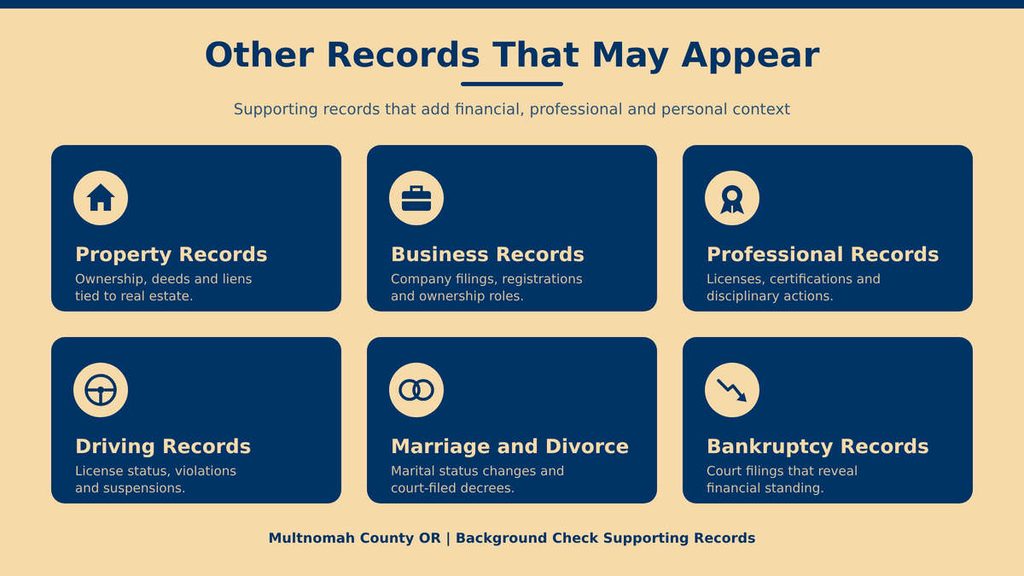
Criminal and civil cases form the core of a background check, but supporting records add useful context. These records reveal financial standing, professional licenses, and personal milestones that often affect screening decisions.
Property Records
Property records document real estate ownership, liens, and transfers. In Multnomah County, the County Assessor maintains an online property search that shows assessed value, tax status, and parcel maps. Background checks often include property data to confirm residency or to identify undisclosed assets.
Business Records
Business records show corporate filings, registered agents, and trade names. The Oregon Secretary of State’s business registry (sos.oregon.gov) lists every active and dissolved entity. Reviewers use these records to verify self-reported employer data or to confirm business ownership claimed on a résumé.
Professional Records
Professional records cover state-issued licenses for occupations such as nursing, real estate brokerage, and barbering. Licensing boards publish license verification pages with status, expiration, and any disciplinary actions. Disciplinary actions appear as public records and can disqualify candidates for roles requiring licensure.
Driving Records
Driving records include license status, points, suspensions, and convictions for traffic violations. The Oregon Department of Transportation (OregonDMV.com) provides a Driver History Report for a fee. Driving records matter for jobs that involve company vehicles or commercial driving.
Marriage and Divorce Records
Marriage and divorce records confirm marital status and past relationships. The Oregon Center for Health Statistics holds vital records from 1909 to the present. Authorized requesters can order certified copies for legal proceedings, though basic index data appears in the public search portal.
Bankruptcy Records
Bankruptcy records cover filings in the U.S. Bankruptcy Court for the District of Oregon. The federal Public Access to Court Electronic Records (PACER) system provides docket access for a small per-page fee. Bankruptcy filings reflect financial difficulty and may affect credit-based or fiduciary employment decisions.
Status of Records Found in a Background Check
Record status determines what a reviewer can do with the information. Active records signal an ongoing matter, closed records indicate resolved cases, and sealed records fall outside the reach of standard background checks under most circumstances.
Active Records
Active records refer to cases still in progress. The docket shows upcoming hearings, pending motions, and unserved warrants. Active status alerts reviewers to potential risk, especially in roles involving fiduciary responsibility.
Pending Cases
Pending cases share traits with active records but typically involve pre-trial stages. Examples include indictments awaiting arraignment or motions under advisement. Pendency may stretch for months due to crowded Multnomah County dockets and the addition of misdemeanor diversion timelines.
Closed Cases
Closed cases have a recorded disposition. The court issues a final judgment, and the clerk archives the file. Closed cases still count toward a person’s history unless a later order seals the record.
Dismissed Cases
Dismissed cases ended without a conviction. Reasons include insufficient evidence, prosecutorial discretion, or successful diversion completion. A dismissal stays on the record, though Oregon law limits its weight in employment screening for most private-sector roles.
Historical Records
Historical records include older convictions that predate digital indexing. The Oregon State Archives holds pre-1970 criminal and civil files on microfilm. Authorized researchers can request access through the State Archives research room.
Sealed or Expunged Records
Sealed or expunged records are removed from public view. Oregon’s set-aside statute (ORS 137.225) allows certain misdemeanor and Class C felony convictions to be set aside after a waiting period. Once set aside, the person can legally answer “no” on most private employment applications, except for law enforcement, childcare, and certain regulated industries.
Verifying Background Check Matches
A search can produce a long list of namesakes. Verification protects the subject and the reviewer by confirming that each entry belongs to the intended person. The process relies on a hierarchy of identifiers and on careful comparison.
Checking Personal Identifiers
Personal identifiers begin with full name, date of birth, and SID. The next-tier identifiers include address history and physical descriptors. When the identifiers align, reviewers can be confident about the match. When they do not align, the entry belongs to a different person and should be excluded.
Matching the Correct Person
Matching the correct person involves a side-by-side comparison of at least three identifiers. The gold standard uses the SID, date of birth, and one address. If the SID is missing, two identifiers plus a biometric (such as a fingerprint match on the original arrest card) provide sufficient confirmation.
Name Matches
Common names such as John Smith, Maria Garcia, or Robert Johnson appear frequently in Multnomah County returns. Every result flagged with the common-name designation must be reviewed individually. The state portal already groups results by date of birth, which shortens the review.
Duplicate Records
Duplicate records occur when the same case has multiple entries due to data transfers, alias filings, or court consolidation. Reviewers should cross-reference the case number to confirm duplicates and avoid inflating the offense count.
Outdated Information
Outdated information appears when records were corrected or updated after the initial filing. The current record reflects the most recent judicial action. Reviewers must request a refresh to capture post-2024 amendments, sentence modifications, or expungement orders.
Incomplete or Conflicting Records
Incomplete or conflicting records happen when one data source has not been synchronized with another. For example, the CCH may show an arrest without a disposition because the court has not yet reported the final outcome. In these cases, the official court docket serves as the deciding source.
Background Check Limitations
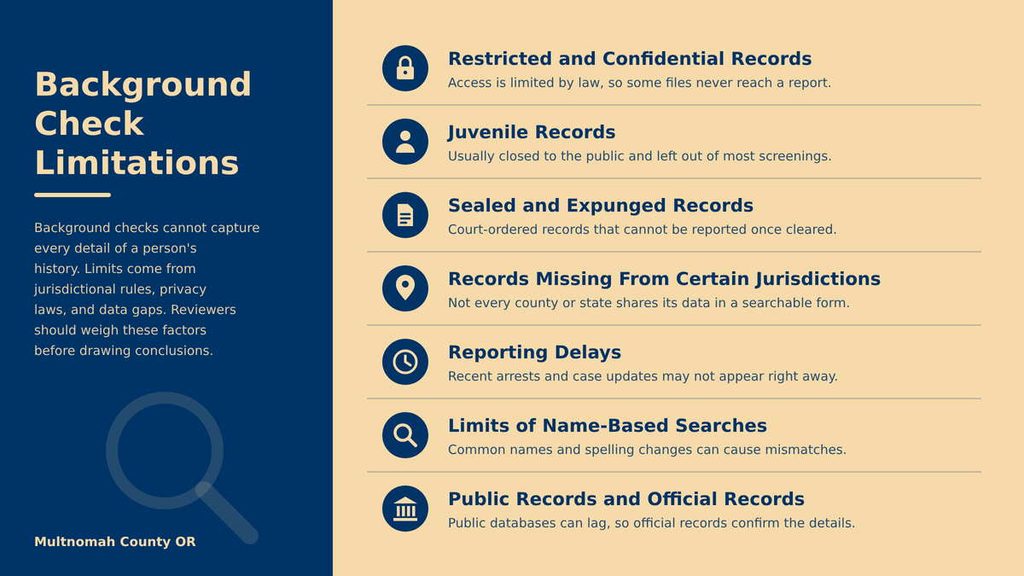
Background checks cannot capture every detail of a person’s history. Limits come from jurisdictional rules, privacy laws, and data gaps. Reviewers should weigh these factors before drawing conclusions.
Restricted and Confidential Records
Restricted and confidential records include juvenile adjudications, mental health commitments, and certain family court files. Oregon laws (ORS 419A.255 and ORS 430.399) keep these records out of general public access. They become accessible only through specific legal processes or to parties named in the case.
Juvenile Records
Juvenile records cover anyone under 18 at the time of the offense. Most juvenile records are sealed upon the subject reaching age 18 if they have no subsequent adjudications. Serious offenses such as Measure 11 crimes can remain open longer, and some juvenile records are never sealed for offenses that would be a felony if committed by an adult.
Sealed and Expunged Records
Sealed and expunged records do not appear in CCH searches once the court enters the order. Reviewers cannot rely on portal results for these records; they must confirm any expungement status directly with the originating court.
Records Missing From Certain Jurisdictions
Records missing from certain jurisdictions happen when an out-of-state court has not transmitted its disposition to Oregon. Federal convictions, tribal court outcomes, and convictions through the official gis map legal records portal to review in other U.S. states stay outside the CCH. Employers requiring nationwide coverage must use the FBI’s Identity History Summary (rap sheet) or a third-party screening provider.
Reporting Delays
Reporting delays often range from 30 to 90 days for disposition data. Court backlogs, processing errors, and staffing shortages can extend this window further. Reviewers should treat data less than 60 days old as provisional.
Limits of Name-Based Searches
Limits of name-based searches show up whenever the subject uses a different legal name, has no recorded middle name, or has a name that translates into multiple spellings. Fingerprint-based searches eliminate these ambiguities but require submission of physical prints.
Public Records and Official Records
Public records and official records: the term “public record” refers to any document accessible under public records law. “Official record” refers to a certified copy issued by the custodian of records. Most background checks use public indexes for speed and only request certified copies for high-stakes decisions.
Privacy and Legal Considerations
Privacy rules govern how background check data may be collected and used. Oregon and federal laws set limits that affect employers, landlords, volunteer organizations, and anyone else conducting screenings.
Lawful Use of Background Information
Lawful use of background information requires a permissible purpose under the Fair Credit Reporting Act (FCRA). Common permissible purposes include employment screening, tenant evaluation, and credit decisions. Using background data for stalking, harassment, or unauthorized profiling violates both Oregon and federal law.
Personal Information Protection
Personal information protection measures come from the Oregon Consumer Identity Theft Protection Act (ORS 646A.604) and the Oregon Identity Theft Protection Act amendments. These statutes require businesses to safeguard sensitive data, provide breach notifications, and allow consumers to place security freezes on credit reports.
Employment Screening Requirements
Employment screening requirements vary by industry. The Oregon Bureau of Labor and Industries (BOLI) enforces ban-the-box rules for public employers, prohibiting criminal history inquiries until after a conditional offer. Private employers must follow FCRA adverse-action procedures when using third-party screening reports.
Consent Requirements
Consent requirements apply whenever a third party runs a background check on behalf of another. The subject must sign a written authorization that names the screening company, states the purpose, and lists the type of records to be reviewed. The FCRA also requires a separate stand-alone disclosure document.
Consumer Reporting Restrictions
Consumer reporting restrictions prohibit reporting arrests older than seven years that did not result in a conviction (for non-FCRA-covered positions). Convictions may be reported indefinitely, and certain salary thresholds extend reporting limits to ten years. Reviewers must filter their datasets to remain compliant.
Record Correction Rights
Record correction rights allow the subject to dispute inaccurate entries. The screening agency must investigate disputes within 30 days and correct or delete the entry when the data cannot be verified. Subjects can also seek correction directly with the originating court or agency under Oregon’s public records correction procedures.
Verifying Background Check Information
Verifying background check findings means going to the source. When a record carries legal or financial weight, the reviewer should pull the certified copy or contact the custodian directly.
Requesting Criminal Records
Requesting criminal records starts with the Oregon State Police CCH request process, which yields a record check with CCH number. For more detail, the subject’s fingerprint cards and original police reports can be requested through the agency’s public records unit. Some agencies charge per-page fees ranging from $0.25 to $1.00.
Requesting Court Records
Requesting court records means contacting the Multnomah County Circuit Court Clerk at 1021 SW 4th Avenue, Portland, OR 97204. The clerk’s office charges $5 for a standard 10-year search of the index, plus per-document fees. Online requests through the Oregon Judicial Department portal add a small convenience fee.
Requesting Driving Records
Requesting driving records requires completing the Oregon DMV Form 735-37 and paying the $9 fee for a three-year record or $19.50 for a ten-year record. The request must include a signed release. Mail and online options exist through OregonDMV.com.
Requesting Professional Records
Requesting professional records depends on the issuing board. Most licensing boards in Oregon provide online verification portals. The Oregon Health Authority, for example, lists real-time license status for health professionals. Disciplinary records require a public records request to the board’s enforcement unit.
Certified Record Copies
Certified record copies include a raised seal and the signature of the custodian. They carry legal weight for court submissions, immigration filings, and name changes. Standard fees range from $5 to $30 per certified document in Oregon, and additional expedited fees apply when faster turnaround is requested.
Official Record Verification
Official record verification concludes the process. Each entry on the background check should be tied to a verifiable document, including the case number, the issuing authority, and the date of certification. When verification reveals an error, the subject can pursue the correction channels listed earlier.
Background Check Search Problems
Even experienced reviewers hit snags during Multnomah County background checks. Knowing the most common problems helps reduce turnaround time and improves accuracy.
No Records Found
No records found can mean the subject has no Oregon history, has only sealed records, or has a common name hidden behind another identifier. Reviewers should add a date of birth, expand name variations, or request a fingerprint-based CCH search.
Too Many Matching Records
Too many matching records usually point to a common name. Add birth year, middle name, or a known address to narrow the results. Multnomah County returns can be especially long because of the county’s large population, so patience is required.
Incorrect Person Match
Incorrect person match happens when the subject shares a name with a more prominent individual. Reviewers must compare identifiers rigorously before drawing conclusions. A single overlapping identifier is not enough; multiple must align.
Missing Records
Missing records occur when a case was filed at a court outside Oregon or under a different identifier. Federal convictions, military records, and tribal court matters may show up only on an FBI rap sheet, not on the CCH.
Outdated Records
Outdated records reflect the system’s snapshot at the time of the query. Recent dismissals, sentence modifications, or expungements may not yet appear. Re-run the search after a 60-day buffer to capture the latest updates.
Restricted Records
Restricted records include any case the court has sealed. They may still affect decisions for specific industries, such as law enforcement or childcare, but they remain hidden from standard searches. Authorized disclosure requests are required.
Conflicting Information
Conflicting information surfaces when the CCH and the court docket show different data. The court docket is the official source. Report any inconsistencies to the originating clerk’s office so corrections can be processed.
Contact Details
Visitors seeking criminal calendar information, warrant-related assistance, criminal history records, or court records can contact the appropriate official agency using the details below. Each office handles different types of inquiries, so selecting the relevant department can help direct questions to the correct source. Review the official online portals for current procedures, record availability, and any applicable access requirements before submitting a request.
Multnomah County Circuit Court (Criminal Calendar and Warrant Questions)
- Phone: 503-378-3070, option 5
- Courthouse: 3565 Trelstad Ave SE, Portland, OR 97317
Oregon State Police CJIS (Computerized Criminal History)
- Portal: https://www.oregon.gov/osp/programs/cjis/Pages/CCH.aspx
Oregon Judicial Department Records Search
- Portal: https://www.oregonrecordsrequest.oregon.gov
Frequently Asked Questions
Background check services help individuals and employers verify identity, review criminal history, and confirm professional credentials. In Multnomah County, searches pull data from state courts, law enforcement, and public archives. Quick access to accurate records reduces hiring risks, supports safe housing decisions, and protects community standards. Knowing how to request a Multnomah County background check, what information appears, and where to find official resources saves time and avoids costly mistakes.
How can I run a Multnomah County background check online?
Visit the Oregon State Police website and select the criminal history section. Enter the full name, date of birth, and any known address. Pay the required fee, then submit the request. Results arrive within a few days and include court dispositions, arrest records, and any pending warrants. For faster service, use the county’s online portal that links directly to state databases.
What information appears in a Multnomah County background check by name?
The report lists all criminal cases filed in Oregon courts for the person, including charges, convictions, and sentencing details. It also shows active warrants, parole status, and any civil judgments recorded in the county. If the individual has no record, the search returns a clear statement indicating no findings. This helps employers confirm eligibility and landlords assess tenant risk.
Can I request a background check by address in Portland?
Yes. Use the county’s property search tool to locate the address, then click the “resident lookup” link. Enter the address and select the resident name to view associated criminal filings. This method is useful for property managers who need to verify the background of current or prospective tenants.
What steps should I take if a Multnomah County background check shows an error?
Contact the Multnomah County Circuit Court at 503‑378‑3070, option 5, and request a correction. Provide the case number, name, and supporting documents that prove the mistake. The court will review the claim and update the record if the error is confirmed. Follow up within ten business days to ensure the change is reflected in future searches.
How do I obtain a background check for employment in Multnomah County?
Employers should submit a written request to the Oregon State Police, including the applicant’s consent form. Include the applicant’s full name, date of birth, and Social Security number. Pay the standard fee and specify the purpose as “employment screening.” Results arrive electronically and contain all relevant criminal history, allowing hiring managers to make informed decisions while complying with state regulations.